17.12.2025.REMOVAL OF CREAMY LAYER IN SC.STs.RESERVATIONS. Former.CJI.GAVAI...by UT News.

PTI....(1)

New Delhi- Chief Justice of India BR Gavai's recent remarks endorsing the exclusion of the "creamy layer" from Scheduled Caste (SC) reservations have reignited a contentious discussion on affirmative action policies in India.
Speaking at the "India and the Living Indian Constitution at 75 Years" programme organised by AP High Court Advocates' Association (APHCAA) at CK Convention in Amaravati, CJI Gavai reiterated his longstanding support for applying the creamy layer principle, originally introduced for Other Backward Classes (OBCs) to SC and Scheduled Tribe (ST) quotas.
He emphasized that reservations should prioritize the most disadvantaged within these communities, stating that the children of an Indian Administrative Service (IAS) officer cannot be equated with those of a poor agricultural laborer. Gavai recalled his observations from a 2024 Supreme Court judgment, where he had urged states to develop mechanisms for identifying and excluding economically advanced individuals from SC/ST benefits to ensure equitable distribution.
His speech has drawn both applause from proponents of reform and sharp criticism from those who view it as judicial overreach into legislative territory, especially given the court's historical stance that creamy layer principles do not apply to SC/ST reservations.
Senior civil servant Nethrapal, (IRS) an IIT-Madras alumnus and IIM-Bangalore graduate, penned a detailed public response on X (formerly Twitter) on Monday, humbly addressing the CJI and outlining why the Supreme Court lacks the authority to legislate on creamy layer implementation for SC/ST communities.
Nethrapal, with 16 years of experience in the Indian Revenue Service (IRS), is a seasoned tax enforcement leader, passionate about ensuring compliance and fairness in the tax system. Known for his writings on social justice and reservations, Nethrapal argued that the Davinder Singh case was narrowly referred to the court solely to determine the permissibility of sub-categorization, a legal barrier first erected by the 2004 EV Chinnaiah judgment and that creamy layer exclusion was never part of the terms of reference.
(2)


CJI BR Gavai advocates for exclusion of creamy layer in SC reservations
Gavai emphasized the evolving nature of the Indian Constitution and the importance of equality, liberty, and fraternity.

"I also went further and took a view that the concept of creamy layer, as has been found in the judgment of Indra Sawhney (vs Union of India & Others). What is applicable to the Other Backward Classes, should also be made applicable to Scheduled Castes, though my judgment has been widely criticised on that issue," Gavai said.
"But I still hold that judges are not supposed to normally justify their judgments, and I still have about a week to go ( retirement)," Justice Gavai further said.
The CJI said over the years, equality or women empowerment is gaining momentum in the country and the the discrimination which was meted out to them was strongly criticized.
He said before he is set to end his journey as the Chief Justice in a couple of days, the last function that he attended happened to be again at Amaravati of Andhra Pradesh while the first one after becoming the CJI was at his native place Amravati in Maharashtra.
Justice Gavai observed in 2024 that states must evolve a policy for identifying the creamy layer even among the Scheduled Castes (SC) and Schedule Tribes (ST) and deny them the benefit of reservation.
Asserting that the Indian Constitution is not "static", Justice Gavai said Dr BR Ambedkar always considered that it has to be evolving, organic, and a state-of-the-art living document as Article 368 provides for the amendment of the Constitution.
According to him, DR Ambedkar’s addresses during the presentation of the draft Constitution in the Constituent Assembly are the most important speeches which every student of law should read.
Quoting Ambedkar he said equality without liberty will take away an incentive of a human being to excel in his life and liberty alone would lead to supremacy of the powerful over the weaker. The trinity of equality, liberty and fraternity would be necessary to take the country forward in achieving the social and economic justice.
He said it is because of the Constitution, India had two Presidents from among Scheduled Castes and also the incumbent is a woman from Scheduled Tribe.
"Coming from a humble background from a school, predominantly in a semi-slum area in Amravati, a municipal school, I could reach the highest office in the judiciary and contribute in my humble way to nation building only because of the Constitution of India,” Gavai said.
He said the Indian Constitution stands on the four pillars of justice, liberty, equality, and fraternity.

CJI BR Gavai Supports Excluding Creamy Layer From SC Reservations
Chief Justice reaffirms stance, cites Indra Sawhney judgment and urges states to define creamy layer for SCs and STs.

CJI Gavai reaffirms creamy layer should be excluded from SC reservations.
He urges states to develop policies to identify creamy layer among SCs and STs.
The Chief Justice highlights equality, liberty, and fraternity as pillars of the Constitution.
Chief Justice of India BR Gavai on Sunday reaffirmed his stance on excluding the creamy layer in reservations for Scheduled Castes (SCs).
Addressing the programme “India and the Living Indian Constitution at 75 Years”, Gavai observed that children of high-ranking officials like IAS officers cannot be compared with those of poor agricultural labourers when it comes to reservation benefits. “I also went further and took a view that the concept of creamy layer, as has been found in the judgment of Indra Sawhney (vs Union of India & Others). What is applicable to the Other Backward Classes, should also be made applicable to Scheduled Castes, though my judgment has been widely criticised on that issue,” he said, reported PTI.
“But I still hold that judges are not supposed to normally justify their judgments, and I still have about a week to go (retirement),” Justice Gavai added.
The CJI noted that over the years, equality and women’s empowerment are gaining ground in India, and discriminatory practices against them have been strongly criticised.
Reflecting on his tenure, Gavai mentioned that his first function as CJI was in his native Amravati, Maharashtra, while his last programme before retirement was held in Amaravati, Andhra Pradesh.
Justice Gavai stated that in 2024, he observed that states should formulate policies to identify the creamy layer even among SCs and Scheduled Tribes (STs) and deny them reservation benefits if they fall under this category.
Highlighting the evolving nature of the Indian Constitution, he said, “Dr BR Ambedkar always considered that it has to be evolving, organic, and a state-of-the-art living document as Article 368 provides for the amendment of the Constitution.” He added that Ambedkar faced criticism both for giving liberal powers to amend the Constitution and for requiring ratification by half of the states and a two-thirds majority in Parliament.
According to PTI, quoting Ambedkar, Gavai said that equality without liberty removes incentives for personal achievement, while liberty alone may lead to the dominance of the powerful over the weak. He stressed that equality, liberty, and fraternity are essential for social and economic justice in India.
Gavai also acknowledged the role of the Constitution in enabling India to have two Presidents from Scheduled Castes and the current President from a Scheduled Tribe. “Coming from a humble background from a school, predominantly in a semi-slum area in Amravati, a municipal school, I could reach the highest office in the judiciary and contribute in my humble way to nation building only because of the Constitution of India,” he said.
He concluded that the Constitution of India rests on the four pillars of justice, liberty, equality, and fraternity, PTI reported.
(With inputs from PTI)

https://www.uniindia.com/cji-gavai-reiterates-support-for-creamy-layer-exclusion-in-sc-reservations/west/news/3644803.html.


- News
- Gavai pushes creamy layer for SC/ST, ignites nationwide debate
Gavai pushes creamy layer for SC/ST, ignites nationwide debate
18-11-2025 12:00:00 AM
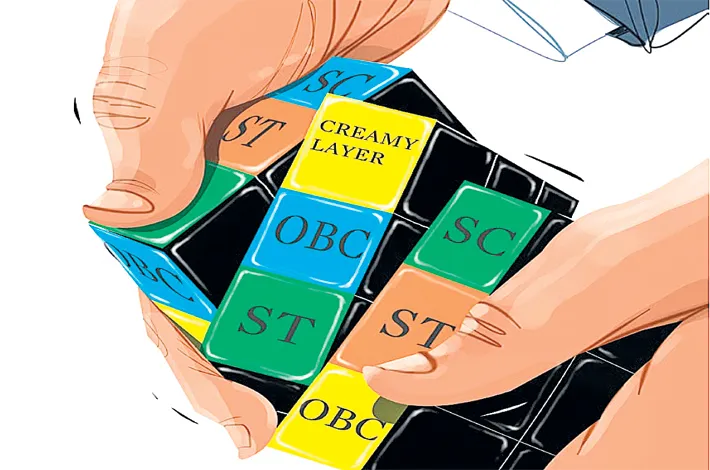
■ CJI Gavai proposes extending creamy layer to SC/ST to target the truly disadvantaged.
■ Critics warn it could hollow out reservation benefits and divide communities.
■ Only a tiny fraction of SC/ST families are wealthy or hold Group A jobs.
■ Political leaders fear creamy layer could be weaponized to dismantle reservations.
■ Legal challenge expected in Supreme Court; debate pits equality versus intra-group fairness.
The debate over India’s reservation policies has once again reached the courtroom and political forefront, this time from the mouth of the retiring Chief Justice of India, B.R. Gavai. Speaking in Amaravati on November 16, 2025, at a program marking “India and the Living Constitution at 75 Years,” CJI Gavai reignited the long-standing controversy over the “creamy layer” in reservations, advocating its extension to Scheduled Castes and potentially Scheduled Tribes. His remarks have stirred fierce discussion: should the benefits of affirmative action be limited strictly to the truly disadvantaged within historically marginalized communities, or does this signal the beginning of a systematic erosion of quotas?
Reflecting on his judicial tenure and personal journey from a humble background in Amravati, Maharashtra, Gavai reaffirmed his long-held position on reservation policies. He explicitly endorsed applying the “creamy layer” concept—already used for Other Backward Classes since the 1992 Indra Sawhney judgment—to SCs and potentially STs. He said, “I also went further and took a view that the concept of creamy layer, as has been found in the judgment of Indra Sawhney, which is applicable to the Other Backward Classes, should also be made applicable to Scheduled Castes. Though my judgment has been widely criticized on that issue, I still hold that judges are not supposed to normally justify their judgments, and I still have about a week to go [before retirement].”
Gavai emphasized that reservation benefits should reach those who are economically and socially disadvantaged. Drawing a stark comparison, he said, “The children of an IAS officer cannot be equated with the offspring of a poor agricultural labourer.” He urged states to devise mechanisms to identify the creamy layer among SCs and STs and exclude them from quota benefits, arguing this approach aligns with the Constitution’s organic nature, as envisaged by Dr. B.R. Ambedkar under Article 368.
The “creamy layer” principle originated in the 1992 Supreme Court judgment in Indra Sawhney v. Union of India, arising from nationwide protests after the V.P. Singh government’s 1990 decision to implement the Mandal Commission report recommending 27 percent OBC reservation in central jobs. The nine-judge Supreme Court, in a 6:3 majority, upheld the quota but excluded the “creamy layer”—OBCs who had already achieved economic or professional advancement—from the benefits. Income, occupation, and social status were the yardsticks. Over decades, the Department of Personnel and Training revised the income threshold from Rs 1 lakh in 1993 to Rs 8 lakh in 2017. Judicial clarifications extended this principle to education through Ashoka Kumar Thakur in 2008 and even to children of constitutional office holders in 2015.
For over three decades, the creamy layer applied exclusively to OBCs. SCs and STs were exempt, given historical disadvantages and systemic marginalization. Even the landmark M. Nagaraj judgment in 2006 upheld SC/ST promotions without imposing creamy layer restrictions. The Union government has consistently opposed its extension to SC/STs, as seen in the 2018 Jarnail Singh ruling and the 103rd Constitutional Amendment, which restored SC/ST promotion benefits without any creamy layer restrictions.
Scholars and policymakers have suggested nuanced approaches to address intra-group inequality without dismantling existing reservations. The graduation principle proposes excluding only third-generation beneficiaries of high constitutional posts or families with sustained incomes above Rs 50 lakh. The deprivation index suggests combining rural residence, landlessness, caste-based labor history, and type of schooling instead of relying solely on income. The one-generation benefit model limits reservation benefits to one generation in education and employment, allowing children of affluent SC/ST families to compete in the general category while retaining protections under the SC/ST Atrocities Act.
Justice Gavai’s Amaravati remarks echoed his 417-page 2024 concurring opinion in the sub-classification case, citing data showing that only 1.13 percent of SC families are in Group A services yet disproportionately benefit from quotas. No state has formally implemented creamy layer rules for SC/STs, though Punjab sub-classified SCs post-2024, stopping short of income-based exclusions.
Tamil Nadu’s 69 percent quota remains untouched. Legal experts predict the issue may soon return to a nine-judge Supreme Court bench. Senior advocate Sanjay Hegde said, “Gavai’s opinion is persuasive but not binding. The court must reconcile Article 14 with Article 15(4) on intra-group equity.”
However, the creamy layer proposal for SC/STs has sparked alarm among political leaders and activists, who warn that it could become a tool to gradually dismantle reservations altogether. Mayawati, in August 2024, cautioned that “first they will impose creamy layer, then raise the income limit every year, and within a decade reservations will be empty.
” Chandrashekhar Azad Ravan added in 2024, “The day a Dalit child of a Class I officer loses reservation, the Brahminical state will celebrate the end of affirmative action.” Jignesh Mevani, in a 2025 interview, framed it as revenge by the upper-caste bureaucracy: “Every time a Dalit becomes an IAS officer, it is treated as a national calamity. Creamy layer is their revenge.”
These concerns are not new. Justice K. Ramaswamy’s dissent in 1992 warned that applying the creamy layer logic to SC/ST would amount to “rewriting the Constitution by judicial fiat.” Even the Indra Sawhney majority recognized the distinction between OBCs and SC/STs, observing that “while the backward classes can be divided into backward and more backward, the Scheduled Castes and Scheduled Tribes form one single class which cannot be subdivided.”
Data shows that the “cream” among SC/STs is microscopic. Government figures reveal that only 4.7 percent of SC households and 6.1 percent of ST households have a regular salaried job in the formal sector, according to the NSSO 78th Round (2021–22). Only 1.13 percent of SC families have a member in Group A central services, a figure cited by Justice Gavai himself in 2024. Less than 0.5 percent of SC/ST students reach elite institutions such as IITs and IIMs, even with reservation benefits. Prof. Sukhadeo Thorat, former UGC chairman, explains, “The cream is so thin that you need a microscope to see it. Excluding it will not free up seats; it will only satisfy upper-caste envy.”
The creamy layer debate goes beyond economics; it challenges the very purpose of India’s affirmative action. While CJI Gavai frames reservations as a tool for uplifting the truly disadvantaged, critics warn it could be a Trojan horse to erode SC/ST benefits, creating social divisions and legal disputes. As India marks 75 years of its Constitution, the discussion highlights the tension between intra-group fairness and protecting historically marginalized communities. With the affluent SC/ST segment being minuscule, questions arise over the necessity of reform. The outcome will influence reservation policy and the broader social and political fabric of the nation.


If a “creamy layer” concept is introduced among SC/STs, it would have major legal, social, and political consequences. We once again explain,
1. What is “Creamy Layer”?
- It means excluding relatively well-off members of a reserved category from reservation benefits.
- Currently applied only to OBCs, not to SCs and STs.
2. Present Legal Position (Very Important)
- Supreme Court (Indra Sawhney, 1992)
→ Creamy layer applies only to OBCs, not to SC/STs. - SC/ST reservation is based on historic untouchability, social exclusion, and stigma, not just economic backwardness.
- Multiple judgments have reaffirmed:
“Economic advancement does not erase caste-based discrimination faced by SC/STs.”
➡️ Introducing creamy layer for SC/STs would require:
- Either a Constitutional Amendment, or
- Overruling established Supreme Court precedents.
3. Possible Effects on SC/ST Communities
A. Positive Effects (Arguments For Creamy Layer)
Supporters argue it may:
- Prevent benefits going repeatedly to the same families
- Ensure poorest SC/ST families get priority
- Reduce internal inequality within SC/STs
- Improve efficiency in distribution of opportunities
B. Negative Effects (Major Concerns)
1. Denial of Reality of Caste Discrimination
- Even educated, employed SC/ST persons:
- Face caste bias in marriage, housing, promotion, social life
- Encounter atrocities and stigma, regardless of income
➡️ Creamy layer wrongly assumes:
“Economic progress = end of caste oppression” (which is false)
2. Large Section Will Lose Reservation Access
- Government employees’ children
- First-generation graduates who crossed income limits
- Urban SC/ST youth
➡️ This may exclude thousands who still face discrimination.
3. Threat to Representation
- SC/ST presence in:
- Higher judiciary
- Academia
- Senior bureaucracy is already very low.
Creamy layer may:
- Further reduce SC/ST representation at top levels.
4. Slippery Slope Risk
- Today: creamy layer
- Tomorrow: income-based quota
- Later: dilution or removal of SC/ST reservation itself
Many fear this is a step towards weakening constitutional safeguards.
5. Administrative Problems
- Income verification issues
- Manipulation & corruption
- Genuine beneficiaries may be excluded due to paperwork errors
4. Special Impact on Scheduled Tribes (STs)
- Many STs live in:
- Remote areas
- Forest regions
- Economically poor but not formally “low income” on paper
Creamy layer may:
- Exclude tribal elites numerically small but socially influential
- Harm isolated tribes who still lack access to education and jobs
5. What Courts Have Recently Said
- Supreme Court has discussed “sub-classification within SCs” (like most backward SCs first).
- But creamy layer for SC/ST has NOT been approved yet.
- Courts stress representation and social backwardness, not just income.
6. Alternative Reforms Suggested (Instead of Creamy Layer)
Many SC/ST scholars suggest:
- Sub-categorisation within SCs and STs
- First-generation learner preference
- Better monitoring of reservation benefits
- Strong anti-discrimination enforcement
- Quality schooling & coaching support
7. Overall Conclusion
If creamy layer is introduced among SC/STs:
- ✔️ Some redistribution may occur
- ❌ But constitutional spirit, social justice goals, and representation may suffer
- ❌ It risks equating economic success with social equality, which India’s caste reality does not support
➡️ Most constitutional experts believe creamy layer is unsuitable for SC/STs.
If you want, I can also:
- Explain Supreme Court judgments in detail
- Compare OBC vs SC/ST reservation logic
- Give data on SC/ST representation
- Provide arguments for debates or exams (UPSC, State PSC, Law)
Just tell me 👍
Sivaji.Ayyayiram
UT News.9444917060.


Comments
Post a Comment