06.12.2025.Dr Ambedkar 69th MahaParinirvan Din spl news.by UT news.Sivaji.


The views of Ambedkar that the ‘Champions of Dalits’ don’t want the public to know
Politicians across the world often prefer to keep the masses ignorant, as it allows them to easily manipulate people. When a leader, like Ambedkar or Patel, emerges from among the common people, their followers frequently begin to idolize him or her. While such admiration is not inherently wrong, the unfortunate reality is that the political successors of these leaders often distort and misuse the legacy of the icon to advance their own agendas.
This tendency is clearly visible in our country as well, and in this article, we will examine how the Congress party, leftists, and their allies have deliberately kept people unaware of many of Ambedkar’s actual views, simply because those views do not align with their political narrative.
Ambedkar on Abrahamic Religions
The Congress, Communists, and certain Dalit (SC – Scheduled Caste) leaders never miss an opportunity to proclaim that Ambedkar despised Hindu Dharma and that he burned the Manusmriti. They portray Manusmriti as the most sacred Hindu Grantha. In truth, it is merely one among many Hindu Granthas and by no means the holiest one. It is beyond the scope of this article to analyze the Manusmriti in detail, but it is sufficient to note here that several misconceptions surround this text. What these leaders conveniently ignore, however, is that Ambedkar was equally outspoken in his criticism of the Abrahamic religions.
To illustrate this, I will quote passages from his book Pakistan or The Partition of India, which clearly demonstrate that although Ambedkar was critical of certain social evils within Hindu Dharma, he was by no means an admirer of Islam — contrary to what many of today’s so-called Ambedkarites would have the public believe.
In the chapter titled “Social Stagnation,” Ambedkar openly discusses various social ills that plagued Muslim society, such as purdah, talaq, child marriage, and the caste system, without softening his words in any way.
Pages 226-227: Take the position of women. It is insisted by Muslims that the legal rights given to Muslim women, ensure them a greater measure of independence than allowed to other Eastern women… the Muslim woman is the most helpless person in the world … her fate is ‘once married, always married’.
She cannot escape the marriage tie; however irksome it may be. While she cannot repudiate the marriage, the husband can always do it without having to show any cause. Utter the word ‘Talaq’ and observe continence for three weeks and the woman is cast away.
Pages 230-232: The Mohamedans observe not only caste but also untouchability. There can thus be no manner of doubt that the Muslim Society in India is afflicted by the same social evils as afflict the Hindu Society. Indeed, the Muslims have all the social evils of the Hindus and something more. That something more is the compulsory system of purdah for Muslim women.
In page 233 he says, “The existence of these evils among the Muslims is distressing enough. But far more distressing is the fact that there is no organised movement of social reforms among the Musalmans of India on a scale sufficient to bring about their eradication …
The Hindus have their social evils … and a few of them are actively agitating for their removal. The Muslims on the other hand, do not realise that they are evils and consequently do not agitate for their removal. Indeed, they oppose any change in the existing practices.”
Ambedkar’s refusal to convert to Christianity or Islam, despite being offered large-scale inducements by both Christian missionaries and the Nizam of Hyderabad, clearly demonstrates his opposition to the Abrahamic religions. He firmly believed that anyone who converted to either of these faiths would, in effect, cease to be a Bharatiya.
Instead, he supported conversion to one of the various Indic religions and encouraged his followers to do the same, stating, “I advise my Dalit brothers to convert to Buddhism and avoid conversion to non-Indic religions.” Ambedkar viewed the Abrahamic religions as a threat to national integration, and this should conclusively settle any doubts regarding his stance on these religions.
His views on the RSS and Veer Savarkar
Ambedkar not only attended an RSS programme in Pune in 1949 but was also impressed—and pleasantly surprised—by the RSS tradition of not inquiring about a fellow member’s caste. He therefore regarded the RSS as a genuinely nationalistic and non-casteist organization.
Furthermore, he appreciated the social reform efforts undertaken by Veer Savarkar and believed that the eradication of the caste system to unite Hindus was essential for the community’s progress. In this regard, he echoed Savarkar’s position (though the topic of Savarkar’s views on Hindutva is a discussion for another day). Savarkar, too, maintained that the caste system was merely a social practice and not synonymous with or intrinsic to Hindu Dharma.
Ambedkar wrote a letter to Savarkar when the latter was presiding over a Mahar conference in Ratnagiri and said “I, however, wish to take this opportunity of conveying to you my appreciation of the work you are doing in the field of social reform. If the Untouchables are to be part of the Hindu society, then it is not enough to remove untouchability; for that matter you should destroy ‘Chaturvarna’. I am glad that you are one of the very few leaders who have realised this.” (Source: Veer Savarkar by Dhananjay Keer).
Some of his other thoughts
Ambedkar urged his fellow SCs to pursue education, as he firmly believed that education was the only path through which the community could overcome poverty and social disadvantage. He was convinced that reservations, something every community now seeks to obtain, should be abolished after a decade. In essence, he had envisioned a time-bound reservation policy, meant as a temporary measure to uplift the underprivileged.
Unfortunately, selfish politicians have continued this policy for more than seven decades simply because it serves their vote-bank interests. Ambedkar wanted his people to progress based on merit, not perpetual dependence on reservations. He was also opposed to Article 370, which granted special status to Kashmir (abolished by the Modi Government).
This article presents a selective overview of his views on various issues. The key point we seek to highlight is that many self-proclaimed Ambedkarites take pride in portraying Ambedkar as anti-Hindu, yet they never reveal the complete truth. Any aspect of his beliefs that does not align with their political narrative is conveniently edited out.
It is far easier to mislead people who have never actually read Ambedkar’s writings and to manipulate them for political gain—a practice that so-called saviours of Dalits have been engaging in for decades. The revival of caste-based politics and the ongoing distortion and misrepresentation of his words for selfish ends are, to say the least, appalling.
It is high time this manipulation is exposed, and the people are presented with the complete and unaltered truth. Only then can they read, analyze, judge, and draw their own conclusions, ensuring that they are no longer deceived by these self-serving Netas who have exploited Ambedkar’s legacy for their own benefit since independence
Courtesy : Hindu Post

Dr.Ambedkar incorporated various Western texts to develop a unique sense of labour in India
BR Ambedkar valued the Fourteenth Amendment to the US Constitution, which was ratified in 1868. This amendment granted equality to African Americans after the Civil War.
In the classic story titled Jenvha mi Jaat Chorli by Marathi writer Baburao Bagul, the central character — Kashinath, a Dalit protagonist — challenges the systemic caste structure by affirming his faith in the Constitution of India. Published in 1963 as part of Bagul’s award-winning collection of short stories of the same name, the story reaffirms Dalits’ faith in their beloved Babasaheb Ambedkar and in the Constitution of India, which he served as the chairperson of the drafting committee and is widely regarded as its chief architect.
However, history has been unkind to Ambedkar, whose thinking and actions went far beyond his banal fencing around reservation or Dalit issues alone. We take a look at some of the lesser-known aspects of Ambedkar’s thoughts, including his initiation of new discourses of manuski (humanity and compassion), his pursuit of civic rights through pragmatic law, and his foregrounding of the Indian principles of constitutional morality.
The manoos (person) behind Dalit literature
Ambedkar played a pivotal role in shaping Dalit literature, drawing inspiration from philosopher John Dewey’s ideas. He emphasised the role of education, social systems, and, primarily, the individual in confronting the systemic inertia that stabilises in favour of dominant classes.
This idea became the driving force behind the architecture of Dalit literature, which began with autobiographies, poetry, and short stories, primarily challenging Victorian modernity and traditional methods long regarded as literary standards. Dalit literature comes from the rejection of, and resistance to, the injustices of the caste system.
Consider this poem titled Empty Advice by poet Pralhad Chendwankar.
This country, which demands.
A pot of blood
For a swallow of water—
How can I call it mine?
Though it gives the world
The empty advice of peace.
Chendwankar’s poem reflects the Dalit struggle for dignity and human rights in India, particularly through the lens of the Constitution.
Marathi author Sharankumar Limbale notes in his book Dalit Sahityache Soundarya Shastra. that Ambedkar’s ideas helped awaken the Dalit community’s conscience.
This achievement focuses on reclaiming humanism and placing people at the centre. Because of this emphasis on manuski, one of Ambedkar’s beloved words, Dalit literature is unique. It promotes inclusivity and speaks for everyone, not just for Dalits.
Dalit literature prompts readers to reevaluate their assumptions and encourages them to delve deeper. It challenges them to move beyond traditional views and engage with the complexities of Dalit society.
Engendering the politics of labour
The distinctions between labour and work have been recognised since Aristotle, influenced by factors such as space, time, and personal experiences. Labour is often associated with physical effort and subservience, while philosophers such as Karl Marx and Hannah Arendt address this differentiation. In contrast, classical liberals, such as John Locke and Adam Smith, primarily focus on labour without acknowledging work as a distinct concept.
Ambedkar (1891-1956), aware of his identity as an untouchable, approached labour and work in the Indian context, incorporating discussions on gender, caste, class, and culture, informed by his education in Deweyan pragmatism and Fabian socialism. Drawing from various texts, including Rousseau’s Social Contract, Marx’s Communist Manifesto, Pope Leo XIII’s Rerum Novarum, and John Stuart Mill’s On Liberty, he developed a unique sense of labour.
Ambedkar’s perspective was evident when he contested the 1936 elections for the Bombay Legislative Council as a candidate of the Independent Labour Party (ILP), which he founded. In his party manifesto and campaign speeches, he presented a synthesis of labour, work, and action. His election symbol—a human figure, in contrast to other parties’ materialistic symbols—reflects his ideal of manuski and his view of labour as a form of qualified humanism.
Later, in his interventions as a Labour member in the Viceroy’s Executive Council, Ambedkar emerged as an organic intellectual, prioritising principles over rigid traditions and continually undergoing pragmatic transformation. The interplay of law, Labour, and societal morals, along with their tangible and intangible impacts, significantly influenced Ambedkar’s socio-political movement.
Ambedkar’s legal acumen
Ambedkar’s pivotal role in drafting the Constitution of India needs no discussion today, and rightly, he is called the father of the Indian Constitution. His writings deeply inspire the masses, especially the Bahujan strata of society, and he stands as a symbol of excellence for them to emulate.
Increasingly, he is gaining recognition for his work, which is drawing international attention for his championing of human rights and challenging patriarchal narratives of his times and inspiring an array of movements not only in India but across the world. His work provides a framework for social activism against injustices related to gender, race, and ethnicity.
Known as the “poor man’s barrister,” Ambedkar valued the Fourteenth Amendment to the US Constitution, which was ratified in 1868. This amendment granted equality to African Americans after the Civil War (1861-1865). It clarifies the phrase “due process of law” when read with the Fifth Amendment. While drafting the Constitution of India, particularly clause 9 of the Advisory Committee on Minorities and Fundamental Rights, this phrase was included: “… Nor shall any State deprive any person of life, liberty, and property without due process of law.”
Legal and constitutional expert BN Rau’s meeting with US Supreme Court Justice Felix Frankfurter raised concerns about the separation of powers among the executive, legislature, and judiciary. This separation could lead to the misuse of due process, as mentioned by him during this meeting, in the context of the Lochner vs New York (1905) case. This led to a tussle between the executive and judiciary, as seen in President Franklin D Roosevelt in 1937, whose statements sparked frictions between the two branches of the state.
Ambedkar, in his debates in the Constituent Assembly, presented himself as a strong advocate of judicial independence, harmonious working between the executive and judiciary, and caution against executive overreach. (These very principles later came to be held as the basic structure of the constitution). However, he recognised the importance of due process of law but wanted to implement it with adequate checks and balances for the people of India.
In September 1949, he defended clauses Article 22(3) to Article 22(7) in a lively debate, saying, “My friends and I have been trying in some way to restore the content of due process of law in its basics without using the term ‘due process.’” This portrays him as a legal visionary who had already predicted and sought to introduce the due process of law. Thus, Ambedkar, a visionary far ahead of his time, anticipated the substantive doctrine of due process of law, a basis for substantive democracy, accompanied by a strong system of checks and balances, making it justiciable and accountable.
Aditi Narayani and Nikhil Sanjay Rekha Adsule (Edited by Saptak Datta)
Aditi Narayani is an assistant professor of sociology at Lakshmibai College, Delhi University. She tweets @AditiNarayani.
Nikhil Sanjay-Rekha Adsule, is a Senior Research Scholar at IIT-Delhi & John Dewey Emerging Scholar, USA. Views are personal.
Courtesy : The Print

How ‘Jai Bhim’ Was Born at a 1938 Marathwada Parishad
The slogan emerged at the Makranpur Parishad as a unifying Dalit greeting in Ambedkar’s presence.
Jai Bhim: These two words have come to symbolise the awakening and empowerment of the Dalit community in independent India, but not many people know how they originated.
The phrase was first used at the Makranpur Parishad, a conference held in Makranpur hamlet in Kannad teshil of today’s Chhatrapati Sambhajinagar district in Maharashtra. It also captures the great respect that Dr Bhimrao Ramji Ambedkar is held in.
On December 6, 1956, Ambedkar, the primary drafter of the Indian Constitution, passed away.
On December 30, 1938, the first Makranpur Parishad was established by Bhausaheb More, the first president of the Scheduled Castes Federation of Marathwada.
According to Bhausaheb’s son, Assistant Commissioner of Police Pravin More, Dr Ambedkar spoke at the conference and urged the populace to oppose the princely state of Hyderabad, which at the time ruled over a large portion of central Maharashtra.
“When Bhausaheb stood up to speak, he said every community has its own deity, and they greet each other using the name of that deity. Dr Ambedkar showed us the path of progress, and he is like God to us. So henceforth, we should say ‘Jai Bhim’ while meeting each other. The people responded enthusiastically. A resolution accepting ‘Jai Bhim’ as the community’s slogan was also passed,” More told PTI.
“My father came in contact with Dr Babasaheb Ambedkar in his early years. Bhausaheb was aware of the atrocities the Nizam state committed on Dalits. He told Ambedkar about these atrocities, including the pressure to convert. Dr Ambedkar was strongly against these atrocities, and he decided to attend the 1938 conference,” he said.
Ambedkar was permitted to travel through Hyderabad state but was prohibited from making remarks there due to his opposition to the princely states. Hyderabad and British India were separated by the Shivna River. According to ACP More, Makranpur was selected as the inaugural conference’s location since it was located in British territory, but on the banks of Shivna.
The brick stage where Dr Ambedkar spoke at the conference is still in place. In order to sustain Ambedkar’s ideas, the conference is held annually on December 30. This tradition was maintained even in 1972, when Maharashtra went through one of the worst droughts in its history.
“My grandmother pledged her jewellery for the conference expenses. People from Khandesh, Vidarbha and Marathwada attended it. Despite a ban imposed by the Nizam’s police, Ambedkar’s followers crossed the river to attend the event,” said ACP More.
“This is the 87th year of Makranpur Parishad. We have deliberately retained the venue as it helps spread Ambedkar’s thought in rural areas,” he added.
Curated by: Snehal Srivastava
Courtesy : Outlook India


Ambedkar’s priceless book collection languishes for want of funds
The state government promised ₹25 crore for restoration two years ago but has still to release the money
MUMBAI: Inside the premises of Siddharth College in South Mumbai lies an academic treasure trove—the entire collection of Dr B R Ambedkar’s books, his notes, the constituent assembly debates and the first printed edition of the Constitution of India. The college has protected this collection for decades but bereft of funds for modern restoration facilities, the challenge of preserving it is growing every year.

Principal Ashok Sunatkari, who took charge in 2021, told HT that the collection included more than 10,000 books belonging to Dr Ambedkar, along with his handwritten notes, rough drafts and rare reference texts. “Experts quoted more than ₹32 crore for restoring these, which we simply cannot raise,” he said.
Sunatkari pointed out that many of the documents were referred to by scholars across the world. Some of the notes were used by Ambedkar while writing his books while others remain unpublished. “We tried approaching funding agencies and explored several avenues,” he said. “Through corporate social responsibility support, we managed to restore a few of Dr Ambedkar’s handwritten notes. But a lot of work is still pending, and it needs to be completed as early as possible.”
In August 2023, the state government, in a meeting with the Parliamentary Committee on the Welfare of SC/STs, approved ₹35 crore in principle for the restoration of the over-150-year-old building and another ₹25 crore to restore the books The then chairman of the committee, Kirit Solanki, penned a letter of appreciation to the government for taking immediate action. However, the funds are yet to be disbursed.
“We are following up regularly,” said Sunatkari. “The building itself, constructed in 1908 and handed over to the People’s Education Society around 1948, needs major repairs. This is the building where Dr Ambedkar used to sit and work.” Ambedkar founded the PES, an inclusive institution modelled on the ideals of Buddha, in 1945.
The library’s collection is extraordinary. It includes more than 1,400 volumes of the House of Commons, the original copy of The Gospel of Buddha by Paul Carus, the books of John Dewey, Ambedkar’s teacher and mentor at Columbia University, rare works on the French Revolution by Rousseau and Voltaire, books on Gandhian thought and biographies of world leaders. Many of these books are not easily available elsewhere. The library also holds the rough draft of the Constitution, Ambedkar’s notes from 1934 explaining terms such as ‘Republic’ and the original copy of the Constitution signed by him, which is now deteriorating with time.
Every year, at least four or five PhD students from foreign universities visit the Siddharth College library. Scholars from Oxford, Switzerland and the UK regularly refer to the rare publications stored here. “The vast collection at Siddharth College represents the intellectual foundation of India’s democracy,” said Sunatkari. “It preserves the texts Ambedkar personally used while shaping the Constitution and studying global democratic systems.” The principal added that to create public awareness about the collection last year, the college opened its library to the general public in the evenings but the response was poor.
The college now aims to digitise the entire collection and make it accessible online. Sunatkari said this was essential for researchers and for preserving the knowledge for future generations. “These rare documents must be digitised and made available to the public,” he said. “But without awareness and funding, this is difficult.”
In October, the state government approved the restoration plan of 11 buildings belonging to the People’s Education Society but it is yet to be executed. Taking the point ahead, Anand Raj Ambedkar, PES chairman and Ambedkar’s grandson, said the institution was trying its best to preserve the documents but had limited resources. “We are constantly in touch with the government,” he said. “These are rare national treasures and their restoration must be funded.”
Despite trying to reach out to officers from the social justice department, none were available for comment.

- Constitution Of India
- /India
- /Dr BR Ambedkar death anniversary 2025: Untold stories of the architect of Indian constitution
Dr BR Ambedkar death anniversary 2025: Untold stories of the architect of Indian constitution
Edited By Kushal DebPublished: Dec 05, 2025, 17:55 IST | Updated: Dec 05, 2025, 18:35 IST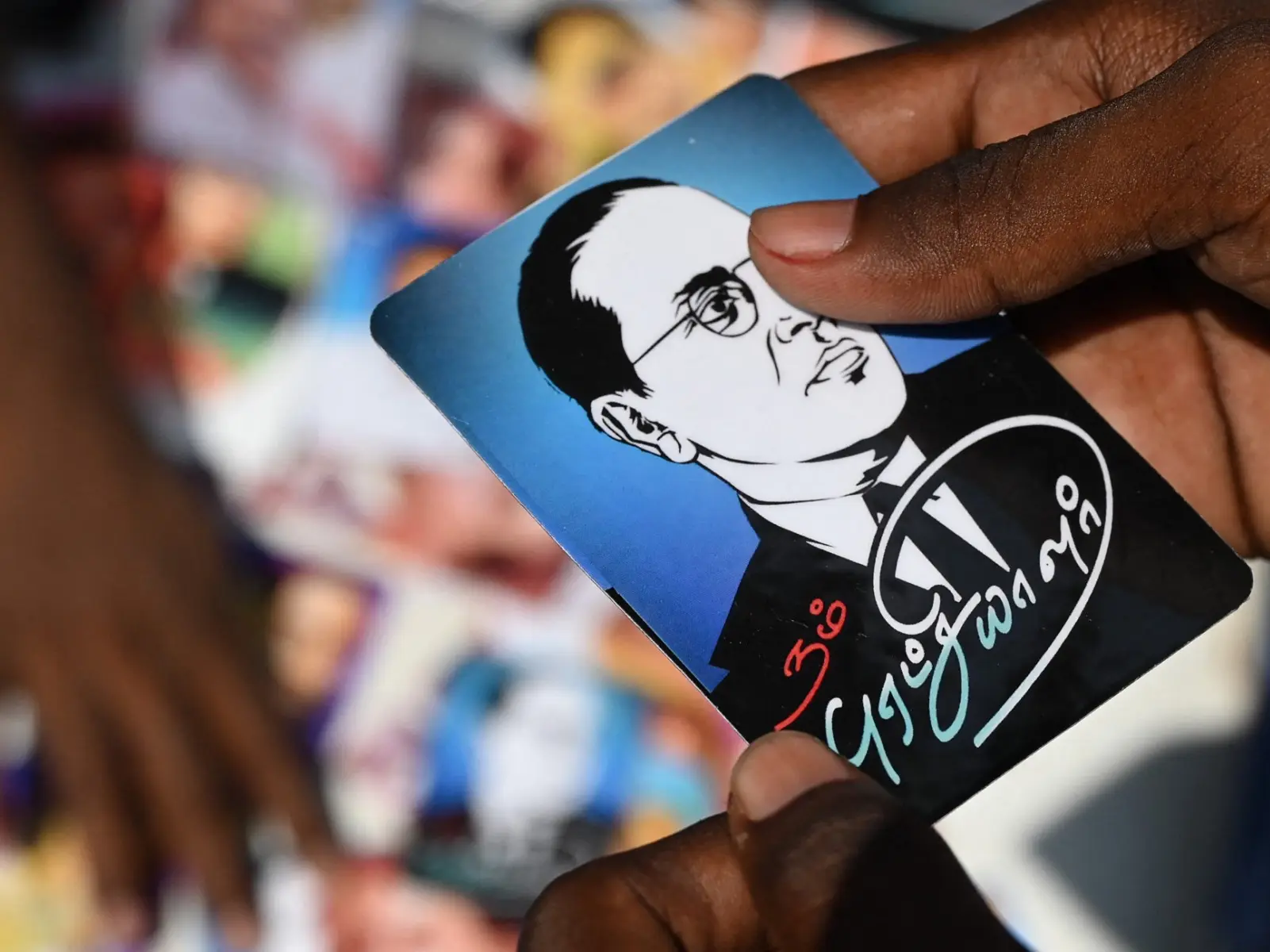&imwidth=800&imheight=600&format=webp&quality=medium "Dr BR Ambedkar death anniversary 2025: Untold stories of the architect of Indian constitution")
A man hold a portrait of social reformer B. R. Ambedkar during an event on the occasion of his birth anniversary in Chennai on April 14, 2022. Photograph: (AFP)
Story highlightsDiscover rare facts about Dr B.R. Ambedkar, from burning the Manusmriti and challenging Gandhi to converting to Buddhism and shaping India’s fight against caste.
Bhimrao Ramji Ambedkar was the social reformer who challenged Indian societal barriers, rejected indignity in all forms and stood up for the marginalised and depressed classes of Hindus. From burning of the Manusmriti, standing against Gandhi to embracing Buddhism, Ambedkar's intellectual and political endeavours have shaped the definition of social justice in India. Eventhough caste pride is still evident, violence against Dalits is still prevalent, he laid the framework for the perpetual battle for the annihilation of caste. Here are some of the lesser-known facts about Ambedkar.
Ambedkar refused to call M K Gandhi 'Mahtama'
In a 1955 BBC interview, BR Ambedkar said that Gandhi "was never a Mahatma", he urged that “Gandhi did not deserve that title”, particularly because of the brand of politics of Gandhi. He said that Gandhism was a dangerous doctrine. Gandhi was a structural functionalist; he believed that social stratification, like class, caste, is there to serve certain functions. “He was just an episode in the history of India, not an epoch maker,” said Ambedkar. Peace researcher Johan Galtunberg said that the error was not in the man but in the structural violence itself. Gandhi, eventhough he recognised it, did not prioritise. His prescription was of an ideal society with an established caste system. However, he later resorted to euphemism to justify his caste support by attributing caste as ‘varna’.
Ambedkar converted to Buddhism
"Hindu religion is a dead religion…Nobody can get deliverance in the Hindu religion," said Ambedkar in Nagpur before converting to Buddhism along with his large followers in 1956. Instead, he presented Buddhism as a religion of equality and culture, where everyone from every caste, creed and community is connected by one thing only, suffering or ‘dukka’. Ambedkar was born in a Mahar family. He faced extreme difficulties due to his caste and poor financial conditions. Much of his intellectual and political struggle was influenced by his life experience.
Ambedkar led the Mahad Satyagraha
Trending Stories
Ambedkar led all his followers to Chavdar Lake, Mahad, Maharashtra, on March 20, 1927, where he violated the long-imposed restriction on Dalits (untouchables) on the use of public water sources. On the eve of the protest, caste brahmins secured a stay order from the court. Against all the odds the act of drinking water from the tank was a symbolic resistance against the established caste system.
Ambedkar Manusmriti Dahan
Ambedkar, in 1927, publicly burnt the text that embodies the hegemony of the caste Hindu. The text Manusmriti perpetuated the caste system, patriarchy, and exploitation of the lower castes. Manusmriti was torn page by page and burnt by Dr Ambedkar, Sahastrabuddhe and six other Dalits. However, there was a single picture of Gandhi in the protest site, implying Dalits were still not disillusioned by him.
Ambedkar advocated for the Dharma Chakra in the Indian flag
Ambedkar pushed to replace the spinning wheel with the Ashok Chakra or Dharma Chakra in the Indian flag. The spinning wheel was the symbol attributed to Gandhi, which implied self-reliance, progress and justice. Ambedkar saw it as bound to a specific time and a political goal. Instead, he suggested the Asok Chakra, which represents India's spiritual, moral foundation, the 24 'wheel of law'.
Ambedkar and the RSS
There is a shift in RSS from burning effigies of Ambedkar to appropriating him. However, Union Home Minister Amit Shah once shouted in the Parliament, “Ambedkar, Ambedkar, Ambedkar”, it has become a new fashion of late. In 1949, just before the drafting of the Indian Constitution, the RSS mouthpiece Organiser wrote that there is nothing Bharatiya about the constitution. The Hindu Code Bill, which addressed issues like intercaste marriage, inheritance and guardianship, was vehemently opposed by the Sangh, took out protests, and burnt its effigies. Now the RSS has shifted its stance from criticism to praise, actively seeking to co-opt Ambedkar's legacy.
About the Author
Tributes to Baba Saheb Dr. Ambedkar: From Labor leader to Nation Builder
December 5, 2025
Arjun Ram Meghwal
Today, we commemorate the 70th Mahaparinirvan Day of Baba Saheb Dr. Bhimrao Ambedkar, a larger-than-life figure and a champion of progressive measures that have shaped the course of modern human society. As a jurist, economist, philosopher, reformer, and above all, a nation-builder, his tireless efforts laid the foundation of modern India. He did not merely draft a Constitution; he provided a blueprint for an inclusive and empowered nation, where every citizen enjoys dignity and opportunity. Inspired by these foundational values, the Modi government has undertaken numerous initiatives promoting welfare and good governance.
On November 27, 2025, at UNESCO Headquarters in Paris, the world paused to witness the unveiling of a bust of Dr. Bhimrao Ramji Ambedkar, commemorating the 75th anniversary of the Indian Constitution. Among global dignitaries, the statue stood not merely as a tribute to an Indian leader but as a universal symbol of justice. The plaque reads “Architect of the Indian Constitution,” yet these words barely capture the legacy of a man who not only drafted laws but helped shape an entire nation in totality.

During his entire lifetimr, Baba Saheb Dr Ambedkar carried forward the struggle for justice, championing for labour rights and welfare. As the representative of the Depressed Classes in the Round Table Conference, he strongly advocated for living wages, decent working conditions, freedom for peasants from oppressive landlords, and the eradication of social evils affecting the downtrodden. He had personally witnessed the suffering of workers and the downtrodden. In Bombay, he lived for over 10 years in one-room tenements of the Bombay Development Department alongside mill workers, where there were no modern facilities and each floor had only one lavatory and one tap for all purposes. These conditions gave him firsthand knowledge of workers’ lives. He mobilized the masses and founded the Independent Labour Party (ILP) in 1936 with a comprehensive program for landless people, poor tenants, agriculturists, and workers. On September 17, 1937, during the Poona session of the Bombay Assembly, he introduced a bill to abolish the Khoti land tenure system in Konkan. In 1938, he led a peasants’ march to the Council Hall in Bombay, becoming a popular leader of peasants, workers, and the landless. He was the first Indian legislator to introduce a bill to end the serfdom of agricultural tenants. He also strongly opposed the Industrial Disputes Bill, 1937, because it curtailed workers’ right to strike.
When the world order was in uncertainty during the 2nd world war, Dr. Ambedkar as a abour Member of the Viceroy’s Executive Council was guiding the path for the labourer in India. As economies transformed and industries expanded, entrepreneurs gained opportunities for prosperity, but labour was not given its fair share. Dr. Ambedkar introduced key measures for labour welfare, laying the foundation of the Government’s labour policy. He handled complex labour issues with great efficiency and earned the respect of both employees and employers.
Discover moreBuddha or Karl MarxBuddha Or Karl MarxJammu Kashmir travel guidesDefence technology exhibitionsPolitical opinion booksNews analysis coursesEducation NewsAISpace exploration toursJ&K Reservation PolicyIn his 1943 All India Radio address from Bombay, Dr. Ambedkar urged securing a “fair condition of life” for labour, grounded in liberty, equality, and fraternity. His efforts helped bring workers under social security. He made lasting contributions through key labour legislation, including the War Injuries (Compensation Insurance) Bill, the Indian Boilers (Amendment) Bill, 1943—addressing unsafe inspections that caused many mill deaths—the Indian Mines and Trade Unions Amendment Bills, the Miners Maternity Benefit Amendment, the Coal Mines Safety (Stowing) Amendment, and the Workmen’s Compensation Amendment.
On 9 December 1943, Dr. B.R. Ambedkar visited the Dhanbad coalfields, going 400 feet underground to inspect operations and labour conditions. This visit led to the Coal Mine Labour Welfare Ordinance of January 1944, creating a fund for workers’ welfare. He strengthened this fund by doubling the tax on extracted coal, ensuring better health and safety measures for miners. On 8 November 1943, he also introduced the Indian Trade Union (Amendment) Bill, requiring employers to recognise trade unions.
On 8 February 1944, during the Legislative Assembly debate on lifting the ban on women’s underground work in coal mines, Dr. B.R. Ambedkar stated, “It is for the first time that I think in any industry the principle has been established of equal pay for equal work irrespective of the sex.” This marked a historic moment for the nation. Through the Mines Maternity Benefit (Amendment) Bill, 1943, he strengthened maternity benefits and addressed absenteeism. In 1945, he further amended the Act to prohibit women from underground work for ten weeks before childbirth and ensured fourteen weeks of maternity leave—ten weeks before and four weeks after confinement.
Addressing the Indian Labour Conference in New Delhi on 26 November 1945, he reviewed the State’s obligations to labour and urged laws to raise Indian labour standards to international levels. Emphasizing the need for progressive labour welfare legislation, he said:—
“Labour may well say that the fact that the British took 100 years to have a proper code of labour legislation is no argument that we should also in India take 100 years. History is not to be studied merely with a view to know how well to imitate the mistakes of other countries. We study history with a view to know the errors people have made and how they could be avoided. History is not always an example. More often it is a warning.”
The next day at the same conference, he proposed legislation to reduce working hours to a 48-hour week in factories, introduce statutory industrial canteens, and amend the Workmen’s Compensation Act, 1934. He also announced plans to draft laws for minimum wages and for amending the Indian Trade Union Act, 1926. On 21 February 1946, Dr. B.R. Ambedkar moved the Factories (Amendment) Bill to reduce weekly working hours to 48, fix overtime rates, and provide paid leave. After review by the select committee, this landmark legislation—championed by Ambedkar—was passed on 4 April 1946.
The Mica Mines Labour Welfare Fund Bill, introduced by him to create a fund for welfare activities in the mica mining industry, was passed on 15 April 1946. It improved amenities and working conditions for child and women labourers, including hours and wage issues. Dr. Ambedkar also moved a Minimum Wages Bill on 11 April 1946, proposing advisory committees and boards with equal employer–labour representation. This bill was later enacted into law on 9 February 1948.
Dr. Ambedkar opposed the labour movement led by communists, rejecting Marx’s totalitarian approach of controlling all means of production. He disagreed with Marx’s view that abolishing private property would end poverty and suffering. In his essay Buddha or Karl Marx, he writes:—
“Can the Communists say that in achieving their valuable end they have not destroyed other valuable ends? They have destroyed private property. Assuming that this is a valuable end can the Communists say that they have not destroyed other valuable end in the process of achieving it? How many people have they killed for achieving their end. Has human life no value ? Could they not have taken property without taking the life of the owner?”
While drafting the Constitution, Dr. Ambedkar placed labour in the Concurrent List to ensure uniform legislation and alignment with international standards. His foresight also eliminated bonded labour by declaring it illegal in the Constitution.
Guided by the Mantra of “Reform, Perform, Transform,” and taking inspiration of Dr. Ambedkar’s values, the government has implemented four comprehensive labour codes—the Codes on Wages, Industrial Relations, Social Security & Welfare, and Occupational Safety, Health & Working Conditions. These reforms aim to ensure universal social security, protect workers’ rights, boost productivity, create jobs, and strengthen India’s economic growth toward a Viksit Bharat by 2047. The Pradhan Mantri Shram Yogi Maan-Dhan Yojana, launched in February 2019, provides old-age protection for unorganised workers, while the Maternity Amendment Act, 2017, extends maternity leave from 12 to 26 weeks and mandates crèche facilities.
As we honor the countless contributions of laborers in nation-building, guided by the enduring spirit of Shramev Jayate, Dr. Ambedkar’s Mahaparinirvan Diwas offers a fitting moment to reflect on the vision and actions of this great nation-builder. His ideals remain a guiding light, inspiring us to achieve the goal of a Viksit Bharat by 2047.
(The Author is Union Minister of State for Law & Justice (I/c) and Parliamentary Affairs, Govt of India)





Great — here’s a ready-made, state-wise summary (16 states/UTs) of how Dr. B.R. Ambedkar’s 69th Mahaparinirvan Diwas (Dec 6, 2025) was observed across India. I picked the biggest/most-reported events and the political highlights so you can see both public gatherings and official/party observances.
1. Maharashtra (Nagpur — Deekshabhoomi) — Thousands gathered at Deekshabhoomi for floral tributes, Buddha Vandana, talks by Buddhist and academic groups, and a coordinated blood-donation drive as part of the remembrance.
2. Maharashtra (Mumbai — Chaityabhoomi & memorial updates) — Massive turnout at Chaityabhoomi (Dadar); city made traffic/security arrangements and state/local leaders attended. Media also reported progress on Mumbai’s Ambedkar memorial project.
3. Telangana (Hyderabad) — State leaders from BRS (K.T. Rama Rao, Harish Rao) paid tributes publicly and linked Ambedkar’s Article 3 to Telangana’s statehood; parties used the day to reiterate policy/pride in Ambedkar’s constitutional role.
4. Uttar Pradesh — Chief Minister and state officials held formal tributes; the day was also used to announce local measures (e.g., statue security, welfare pledges) in response to recent incidents and as symbolic tribute.
5. Karnataka (Bengaluru / Vidhana Soudha) — Large official commemorations at the Vidhana Soudha; the occasion saw sharp political debate (CM Siddaramaiah criticised HD Kumaraswamy’s proposal on the Gita, calling him “manuvadi”) — Ambedkar’s day was therefore both homage and a stage for ideological contrast.
6. Tamil Nadu — State leaders (CM and Governor) paid tributes and used public statements to highlight Ambedkar’s anti-oppression legacy; opposition and ruling parties framed the day to underline secular/constitutional values.
7. Andhra Pradesh — Official ceremonies and tributes by the Chief Minister and local bodies; media coverage emphasised Ambedkar’s role in constitutional safeguards and social justice.
8. Gujarat — Universities and Ambedkar chairs/committees held tributes, seminars and campus events honouring his scholarship and constitutional contribution.
9. Delhi / Central observance — The Prime Minister, President, Vice-President and other dignitaries paid floral tributes at the Parliament/Prerna Sthal; the central observance set the national tone for the day.
10. West Bengal (Kolkata) — The Chief Minister and state leaders paid homage; public events underlined Ambedkar’s contribution to constitutional democracy and Bengal leaders used the day to speak against communalism.
11. Odisha — Official tributes reported (including mentions of national leaders’ visits/tributes in the region); state ceremonies and local programs remembered Ambedkar’s constitutional work.
12. Jharkhand / smaller eastern districts — Local Ambedkar groups and social-justice organisations held remembrance meetings, floral tributes and discussion sessions in district towns — continuing the grassroots pattern outside big cities.
13. Bihar (Patna) — State leaders (CM and others) offered floral tributes in Patna; local media/photonews covered official ceremonies and calls to implement Ambedkar’s social-welfare ideals.
14. Punjab — State leaders (including the CM) paid public tributes; political parties used statements to criticise opponents and re-affirm commitment to Ambedkarite values.
15. Rajasthan / Himachal / Haryana (selected northern states) — Governors/Chief Ministers in these states held formal floral tributes at Raj Bhavans, public programmes and departmental events; several administrations reiterated social justice commitments.
16. Kerala (and other southern pockets) — Cultural and academic programmes (films, talks, screenings) and official tributes marked the day; Kerala media ran features on Ambedkar’s life as part of the anniversary coverage.
Quick takeaways
- Two kinds of observances dominated: (a) mass public gatherings at Ambedkar memorials (Deekshabhoomi, Chaityabhoomi, city statues, university events) and (b) official/political tributes by governors, CMs and national leaders.
- The day was also used as an occasion for political messaging — several state leaders used their tributes to underline policy positions or criticise opponents.

 PMINDIA
News Updates
PM pays tribute to Dr. Babasaheb Ambedkar on Mahaparinirvan Diwas
The Prime Minister said that Dr. Ambedkar’s unwavering commitment to justice, equality and constitutionalism continues to guide India’s national journey. He noted that generations have drawn inspiration from Dr. Ambedkar’s dedication to upholding human dignity and strengthening democratic values.
The Prime Minister expressed confidence that Dr. Ambedkar’s ideals will continue to illuminate the nation’s path as the country works towards building a Viksit Bharat.
The Prime Minister wrote on X;
“Remembering Dr. Babasaheb Ambedkar on Mahaparinirvan Diwas. His visionary leadership and unwavering commitment to justice, equality and constitutionalism continue to guide our national journey. He inspired generations to uphold human dignity and strengthen democratic values. May his ideals keep lighting our path as we work towards building a Viksit Bharat.
Bros.Sistrs.If you have program please send it to WA.9444917060.Sivaji.to publish.Thanks.Jao bhim.Sivaji.UT news.
Jaibhim.UT News.Sivaji


Comments
Post a Comment