11.12.2025...Sivaji's..Untouchables News in India.by Team Sivaji.9444917060.follow us in all Social Media.


Social Workers in Bulandshahr Arrange Marriage of Dalit Girl: Setting an Example of Humanity in Sunpeda Village of Kakod, Many People Present
In Sunpeda village of Kakod police station area in Bulandshahr, social workers have set an example of social unity by arranging the marriage of a Dalit girl according to Hindu rituals.
According to the information, the girl belongs to a Dalit family. Her father, the late Indrapal Jatav, passed away several years ago. Her mother supports the family by working as a laborer, due to which the family’s financial condition was weak. Bearing the expenses of their daughter’s marriage was a major challenge for the family.
When village social worker Sheel Pradhan learned of this situation, he immediately took the initiative. He organized his associates, including Rinku Bhati, Krishna Sharma, Krishna Mistry, Yogesh God, Jitendra, Shekhar Dabar, Kalua Bhati, and Sarjeet, to arrange the marriage.
All the social workers together assured the family, saying, “She is not just your daughter, she is our daughter too. Her marriage will be celebrated with great pomp and show.” They then took full responsibility for the wedding and conducted the marriage according to Hindu rituals.
This noble act is being widely appreciated in the area. Villagers say that the social workers not only supported a family but also gave a message of unity, humanity, and mutual cooperation to society.
There is an atmosphere of joy in the village because of this initiative, and people are praising the social workers.
Mohit Bhati
Courtesy: Hindi News

Untouchable Goa by Dadu Mandrekar (1997) – A Review by Sampurna Dutta
Dadu Mandrekar’s Untouchable Goa (published in Marathi in 1997), rendered into English through Nikhil Baisane’s (published by Panther’s Paw Publication in 2025) layered and attentive translation, is a powerful sociological archive that exposes caste in a region often reduced to the postcard image of beaches and heritage-rich towns.
Across eighteen essays that traverse the maharwadas of Goa’s villages, Mandrekar—writer, journalist, and Ambedkarite activist—constructs a counter-map of the state, highlighting some of its most invisibilised spaces. I approach Untouchable Goa through three interlinked pillars: the maharwadas as infrastructures of caste, death as a mechanism of Brahminical control, and superstition as a material and moral economy.
Mandrekar maps the state’s maharwadas—Dalit settlements pushed to the village outskirts, often bordering forests or water bodies that swell dangerously during the monsoon, and typically beyond the reach of the state’s infrastructural gaze. He renders each dwelling an index of economic neglect and a site of endurance. Government housing schemes surface as 1,200–2,000-rupee grants intended to fund entire homes in contexts where installing a functional toilet alone might cost 10,000. In a rare instance, they appear as a failed experiment in socialist “uniformity”. Units are childishly conceived to erase caste boundaries. They are crumbling and ill-maintained, yet statistically “complete.”
A passage from this chapter describes a tap installed in a tattered village; a lone functioning emblem of “development”- capturing this paradox with devastating precision. These homes, like their inhabitants, are barely built to survive, let alone live. Subsidies exist largely as bureaucratic data points, disbursed without provisions for repair or maintenance. The Dalits who inhabit maharwadas do not own the land it stands on, nor the land where they will one day be buried—an unbroken circle of dispossession that renders their bodies “owned” by Brahminism in living labour and in death.
In the chapter “365 Devchaar”, Mandrekar visits a maharwada in Dhargal, where an old man narrates what begins as ancestral history but gradually reveals itself as myth. He speaks of devchaars, betaals, and a god who, aided by a man, banishes Vetal from his throne. When the protagonist, Pavne, receives water from a Mahar, he loses his caste. Pavne is rewarded with land for banishing Vetal, which, according to local lore, explains why some Mahars in Dhargal still nominally possess land.
Mandrekar reads these mythic residues not as distortions of history but as evidence of how ownership itself is shaped by caste memory. He situates the story within a reality where, even when bahujans legally own land, they must still seek permission from the original Brahmin proprietors to build on it—a spiritual and social contract that lays bare the feudal motivations of Brahminism.
If home marks the beginning of Mandrekar’s sociological map, death forms its moral and material core. In the second chapter, “Desecrating the Dead,” he examines a grotesque ritual of exhumation in which lower-caste men are bound to dig up graves and participate as drum-beaters in the procession. These bodies are then dismembered and paraded through the night before being discarded. Mandrekar analyses this hideous practice not as a cultural aberration, but as violence enforced through faith.
The Brahminical logic of untouchability, Mandrekar observes, seeps even into mahar households. Among Dalits themselves, contact with a menstruating woman demands purification through gomutra, tulsi water, bathing, and changing clothes—rituals that are unmistakably Brahminical in form. The burden of humiliation trails bahujan women intimately.
When menstruating or pregnant women die, their corpses are buried without ceremony, often in unmarked places, their faces turned groundwards to prevent them from returning as “vengeful spirits.” Mandrekar intuits an economic ‘fear’ behind this superstition: these rituals are meant to guard family wealth from women who, in death, might return to claim property once denied to them in life.
Mandrekar expands the idea of ritual as a sociological archive, tracing the “traditions of death” where the humiliation and economic dispossession of Dalits are most visceral. He refuses to dismiss superstition as quaint or irrational, instead locating its persistence in material and political realities.
Mandrekar observes that mahar traditions (whether deities or celebrations) are modest, symbolic, and exposed to the elements, much like Dalits themselves. But over time, these have been displaced by Brahminical practices such as angat yene and devdevski. Dalits must now spend heavily during Hindu festivals, sinking into cycles of never-ending debt. “They barely pay off one before another comes,” Mandrekar notes, showing that belief itself becomes a form of bondage.
Superstition, Mandrekar shows, is also a survival strategy shaped by precarity. Dalits participate out of belief but also fear of persecution by upper-caste men and the consequences of stepping outside caste-bound occupations such as bamboo work, cleaning, or leatherwork. Mandrekar notes that their modest homes are sometimes targeted for demolition under the rhetoric of modernisation, mirroring the contemporary demolition of Muslim neighbourhoods across India.
Untouchable Goa is a vital ethnographic companion to recent scholarship on caste in Goa by Parag Parabo (2023), Kaustubh Naik (2017), and Jason K. Fernandes (2020). Parabo’s 2023 work, which distinguishes between the Old and New Conquests, analyses the latter as being aligned with Brahminical consolidation following a period of colonial Christian influence—a process that Mandrekar charts through his fieldwork. While Portuguese colonisation itself remains largely absent in Mandrekar’s account, his ethnography provides a rich archive that complements studies of Goan temple politics, landholdings under colonial regimes, and the intersection of Christianity and Brahminism in defining the asprushya or untouchable, as explored by Parabo and Fernandes. Mandrekar specifically documents the everyday realities of home, ritual, and death in post-independence Goa, when Brahminical consolidation became increasingly visible. Untouchable Goa transforms accounts of caste abuse into evidence, offering a necessary corrective to Goa’s sanitised public image and an essential resource for students of the political economy of caste in the region.
The Deras: Culture, Diversity and Politics by Santosh K. Singh (2025): A Review by Neha Sharma
Courtesy : Doing Sociology

Principal beats Dalit student with a bat in Raebareli, child seriously injured with a head injury, allegations of caste discrimination also made
UP News: In Raebareli, the principal of Raghavpur Primary School attacked a Class 1 student, Hrithik, on the head with a cricket bat, causing a severe head injury.
Madhav Singh, Raebareli: A serious incident occurred on Tuesday afternoon at Raghavpur Primary School in the Bachhrawan police station area of Raebareli, Uttar Pradesh, involving 6-7-year-old Hrithik, son of Ram Baran, a student of Class 1. It is alleged that the school principal struck the student on the head with a cricket bat over some issue. The blow was so forceful that the child’s head was split open and he started bleeding profusely.
Injured student taken to the hospital
Immediately after the incident, the student was taken to the hospital in a serious condition for treatment. Upon learning of the incident, the family and villagers became enraged.
Family and villagers express outrage
The family informed the police by calling 112. The villagers alleged that not only are children subjected to physical abuse, but also untouchability and caste discrimination. In protest, the villagers surrounded the school and demanded action against the principal.
Police registered a case
The police arrived at the scene, calmed the situation, and asked the family to file a complaint at the police station. On Wednesday, the family filed a complaint at the police station, seeking justice.
Edited by: Devesh Pandey
About the author
Devesh Pandey is a consultant at Navbharat Times Online. He has 8 years of experience working in TV channels and digital media. He has experience and interest in politics and sports. He covered several IPL matches and the World Cup 2023 in Lucknow.
Courtesy: Hindi News

J&K’s Valmiki Community Added to Scheduled Caste List, Union Govt Informs Parliament
Jammu and Kashmir’s Valmiki community has now been officially added to the Scheduled Caste list, the Union Ministry of Social Justice and Empowerment told Parliament on Wednesday. The announcement was made in a written reply in the Rajya Sabha while listing caste inclusion proposals processed in recent years.
Minister of State Ramdas Athawale said that Jammu and Kashmir had sent two proposals in the past four years. One of them, related to the Phalahre community, was sent back to the administration because the Registrar General of India wanted more justification. But the proposal for including the Valmiki community had already been approved. “The Valmiki community has now been added to the Scheduled Caste list,” he said.
Athawale explained that State and Union Territory governments regularly submit requests to include or remove communities from the Scheduled Caste list. These proposals are examined under fixed rules and must be cleared by both the Registrar General of India and the National Commission for Scheduled Castes. “Only after both bodies agree can the government begin the legal process under Article 341(2),” he said.
He placed data before the House showing that several States have sent similar proposals in the last four years. He noted that each request is examined using demographic information and historical records. “All proposals have been processed according to the laid-down procedures, and the government continues to review the submissions,” Athawale said.
Courtesy : TOP

Principal beats Dalit student with a bat in Raebareli, child seriously injured with a head injury, allegations of caste discrimination also made
UP News: In Raebareli, the principal of Raghavpur Primary School attacked a Class 1 student, Hrithik, on the head with a cricket bat, causing a severe head injury.
Madhav Singh, Raebareli: A serious incident occurred on Tuesday afternoon at Raghavpur Primary School in the Bachhrawan police station area of Raebareli, Uttar Pradesh, involving 6-7-year-old Hrithik, son of Ram Baran, a student of Class 1. It is alleged that the school principal struck the student on the head with a cricket bat over some issue. The blow was so forceful that the child’s head was split open and he started bleeding profusely.
Injured student taken to the hospital
Immediately after the incident, the student was taken to the hospital in a serious condition for treatment. Upon learning of the incident, the family and villagers became enraged.
Family and villagers express outrage
The family informed the police by calling 112. The villagers alleged that not only are children subjected to physical abuse, but also untouchability and caste discrimination. In protest, the villagers surrounded the school and demanded action against the principal.
Police registered a case
The police arrived at the scene, calmed the situation, and asked the family to file a complaint at the police station. On Wednesday, the family filed a complaint at the police station, seeking justice.
Edited by: Devesh Pandey
About the author
Devesh Pandey is a consultant at Navbharat Times Online. He has 8 years of experience working in TV channels and digital media. He has experience and interest in politics and sports. He covered several IPL matches and the World Cup 2023 in Lucknow.
Courtesy: Hindi News

Uttar Pradesh: Seven people barged into a Dalit’s house and attacked them with weapons after an argument; two accused arrested
Uttar Pradesh News: A serious attack has been reported from Mau district of Uttar Pradesh. Late Sunday night, seven people stormed into a house in the Mauaima area. The attackers entered the house armed with sharp weapons and sticks. They launched a deadly attack on two people in the house, leaving them seriously injured.
The incident took place at the house of Kalawati Devi, a resident of Katra Dayaram Panpati Chauraha. The attackers targeted her brother-in-law Jiyalal and her husband’s elder brother Ramabhilash. The attack was so brutal that both were left covered in blood. The victim’s family alleges that the attackers were hurling abuses and also threatening to kill them.
Villagers apprehended two attackers
Hearing the commotion during the attack, villagers from the surrounding area rushed to the scene. Seeing the villagers approaching, the attackers started to flee. They left their bikes and scooters behind. While fleeing, the villagers managed to catch two of the attackers. The remaining five accused managed to escape. The villagers handed over the apprehended accused to the police.
The two arrested accused have been identified as Shiva DJ and Rajaram. The police immediately arrested both of them. The arrested accused were produced in court on Tuesday. The court has sent both of them to judicial custody. The police are now searching for the remaining attackers.
The injured were admitted to the hospital
Jiyalal and Ram Abhilash, who were seriously injured in the attack, were immediately taken for treatment. They have been admitted to SRN Hospital. According to hospital sources, both are still in critical condition. The police have started an investigation into the incident and action is being taken against all the accused in the case.
The victim, Kalawati Devi, has filed a complaint at the Mauaima police station. The complaint names seven people, including Vikas Kumar, Rajaram, and Shiva DJ. The complaint includes charges of attempted murder as well as other serious allegations. The police have registered a case on this basis.
Case registered under the SC/ST Act
The police have also applied the provisions of the SC/ST Act in this incident. This law provides protection to the weaker sections of society. Cases registered under this act are dealt with promptly. The police say they are trying to arrest all the accused as soon as possible.
Local people are shocked by this incident. They say that such incidents are a challenge to law and order. The police administration has taken cognizance of the matter and taken swift action. Now the focus is on the arrest of the remaining accused. Police teams are searching for them.
Courtesy: Hindi News


When Dalit demands and upper-caste anxieties collided in the making of India’s Constitution
Rohit De and Ornit Shani’s new book, Assembling India's Constitution: A New Democratic History, traces the demands put forward by Dalit organisations, upper-caste groups, and individual petitioners — each articulating their fears, ambitions, and visions of justice for the new republic as the Constitution took shape.

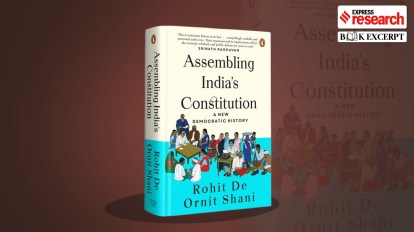 Rohit De and Ornit Shani's new book shifts attention outside the halls of the Constituent Assembly to the diverse public opinion that helped shape the constitution.
The making of India’s Constitution was a remarkably lively affair. While most scholarship has focused on the spirited debates within the Constituent Assembly, a new book by Rohit De and Ornit Shani shifts attention outside those halls to the diverse public opinion that helped shape the document. The Constitution, after all, was never only about institutions or abstract doctrines — it was deeply entangled with lived social realities.
No system shaped everyday life in India more pervasively than caste. The Constitution held out the possibility of transforming this entrenched social order. The following excerpt from De and Shani’s book, Assembling India’s Constitution: A New Democratic History, published by Penguin, traces the demands put forward by Dalit organisations, upper-caste groups, provincial associations, and individual petitioners — each articulating their fears, ambitions, and visions of justice for the new republic.
 While Dalit groups pressed forcefully for the enforcement of equality and the dismantling of caste-based obligations, upper castes expressed anxiety about a constitutional order that could unsettle existing hierarchies. Some even sought to anchor the future Constitution in ancient Hindu scriptures and traditions.
What emerges is a vivid portrait of Constitution-making as a mass, contested, and often fractious democratic exercise — one driven as much by mobilisation on the ground as by elite deliberations inside the Constituent Assembly.
Excerpt:
The principles and ideas that Indians channelled into their conception of an ideal constitution were informed by their daily life. Caste is one of the most important determinants to Indians. Caste not only placed all Indians on a hierarchy, it also determined what work one did, where one could live, who one could marry, what one could eat and with whom, among other things. The constitutional imaginations that were unshackled in 1946 declared, in Upendra Baxi’s words, ‘a normative war against the foundational violence’ of caste hierarchies. Indeed, the constitution ultimately outlawed untouchability, serfdom, and bonded labour, and provided for redistributive justice through affirmative action in ways that were unprecedented in comparative constitutionalism at that time. It is therefore not surprising that the most intense struggles were over the constitution’s potential to radically change the social order based on caste.
When Mr S Uppiliappan of Kattunedungulam village, in the Sivaganga district, read an announcement in the newspapers regarding proposed constitutional safeguards for minority communities, he decided he should write to the Constituent Assembly. He wrote his memorandum by hand, in Tamil. The secretariat of the Constituent Assembly, despite being headed by Tamilian, was unable to decipher the letter. They forwarded it to the Press Information Bureau in New Delhi, which was also headed by a Tamilian, for assistance. But he, too, was unable to translate the letter, and so he sent it to the regional office of the Press Information Bureau in Madras. In a one-page note in English, the Madras Bureau wrote that the memorandum ‘is unintelligible in several places’, and that ‘it is not possible to make out what he [Mr S Uppiliappan] means’. With some ‘difficulty’, however, the Bureau identified Mr Uppiliappan’s key points, which centered on special privileges and safeguards for his community in the constitution. The Bureau could not identify the community the author belonged to, but believed that it was a Hindu minority community, and speculated that he might be a ‘scheduled caste’ or dalit.
The Madras Bureau likely thought this because Mr Uppiliappan demanded, for instance, that ‘members of his community should have’ freedom of worship and autonomy to manage their own community. But these demands could equally have been made by a member of an upper caste or a scheduled caste. Indeed, his demand that ‘localities’, urban and rural, where people of his community reside should be constituted into separate self-governing “colonies”, entry into which should be restricted to people of his own community and ‘creed’, could represent the aspiration for constitutional guarantees of either group. Upper caste groups might be seeking to protect themselves from anticipated changes that might dismantle ritual and caste segregation. But scheduled caste groups might be demanding ‘separate settlements for untouchables to improve their economic position and escape discrimination by caste Hindus [upper castes]’, and to ensure that the transformation in the social order would not fall short of the promises made to them.
Already, both provincial legislatures and princely states had begun to pass laws prohibiting and punishing caste discrimination, exacerbating these different anxieties. Dalit parties, associations, and individuals started to prepare for their self-determination within the future constitution. Their sense of determination and urgency was driven by the fact that the British had failed to ensure any specific safeguards for scheduled castes during the transfer of power negotiations. Nor had dalits been recognised as a separate group (like Muslims and Sikhs) deserving distinct representation in the Constituent Assembly. Instead, they had been included in the “General” category along with caste Hindus and all other minorities. Dalit organisations took to the streets to remind future constitution makers that ‘sixty million people with democratic rights cannot be crushed’.
From the 1930s, dalits had organised at an all-India level under two broad umbrella organisations, the All India Depressed Castes League, which was closely linked to the Congress Party, and the Scheduled Caste Federation (SCF), whose leaders included Dr B R Ambedkar. Much has been made of the ‘crisis’ of dalit politics in 1946, and the apparent divide over rights and representation between these parties, but dalits’ constitutional demands show wide consensus across organisational lines.
In June and July 1946, the SCF protested the betrayal of dalit interests in the future constitution by the Cabinet Mission, which did not allot them separate representation in the Constituent Assembly. In Bombay and Poona, hundreds of dalits demonstrated, carrying black flags, defying police orders, and courting arrest. In the aftermath, the Congress Party and the SCF began negotiating over revisiting certain constitutional arrangements around scheduled castes. In mid-November 1946, dalit members of the legislative assemblies across India and dalit representatives who had been elected to the Constituent Assembly held a two-day convention in Nagpur at which they drafted a brief for the scheduled castes members of the Constituent Assembly. While most of them were members of the Congress party, they assembled outside of the party structure with the intention of forming a lobby with a distinct agenda and a common set of interests. The resulting Harijan [scheduled castes] Advisory Committee included several leaders who were not members of the Constituent Assembly and was distinct from the official Advisory Committee that the Constituent Assembly set up in February 1947.
The recommendations of this group make clear that they understood the limits of conventional liberal rights that sought liberty from the state. Their freedom and emancipation depended on their ability to escape violence and discrimination from other castes, including their neighbours. For example, they wanted to ensure that their right to free speech would not affect their employment or physical well-being. Given the hostility that the dominant upper castes had thus far shown towards scheduled castes’ attempts to enter the public sphere, dalit leaders knew it was insufficient to guarantee the freedom of speech without also protecting them from social consequences, like economic boycotts and dismissal from employment, or from actual violence.
While most groups asked for freedom of occupation, the scheduled caste members also wanted protections from being forced into degrading occupations, such as scavenging or the removal of dead cattle. They demanded an express constitutional provision that persons should not be forced to perform certain ‘social, religious and public functions’ on account of their birth, with attempts to force people to do so subject to criminal prosecution. Dalits were often forced by social pressure, physical violence, and economic sanctions to continue to perform labour and services, such as forced agricultural work or cleaning latrines and drains, that were considered unclean or degraded and were often demeaning. The Gandhian campaign against untouchability often sought to valorise this work, so as to confer dignity to labour and to encourage other castes to take it. The scheduled caste leaders, however, were clear in their goals for the constitution: they wanted the option to exit this degraded work. In this, they shared Dr Ambedkar’s argument that liberty should mean the right to choose one’s profession; to be compelled to carry on the work assigned by their caste was a form of slavery.
These leaders moreover recognised that liberal rights would have little value in an economic system where most dalits were poor and landless and depended on upper castes for employment. In the brief produced for the scheduled caste members of the assembly, the dalit leaders demanded that all lands should be nationalised and settled by ‘persons who have no religious or social prejudice’. Until that was possible, they asked that only members of the scheduled castes be granted the ‘nationalised agricultural land’. In this, the brief echoed a memorandum by Dr Ambekdar, which argued that state socialism was necessary for liberty in a caste society. He argued for a ‘connection between individual liberty and the shape and form of an economic structure of society’. In his view, state socialism and redistribution would be necessary to protect the rights of individuals from encroachment by other individuals. Otherwise, what freedom of speech could a landless dalit agricultural labourer exercise against his landed, upper-caste neighbours?
Across parties, then, dalit political leaders shared an understanding of the limitations of ordinary constitutional rights and a scepticism of the ability of an upper caste-led Constituent Assembly to deliver them. It is striking that the Scheduled Caste Legislators Convention not only circulated their brief among their own members, but also sent 700 copies to the British parliament to inform every British MP about their demands. Seeking to direct and control social reforms for the scheduled castes, dalit groups mistrusted the upper caste-led anti-untouchability movement of the time, claiming that these were intended to fundraise in the name of the scheduled castes without actually involving them in the organisation. In their view, it was upper-caste Hindus who needed to be the object of reform, and not dalits. The general secretary of the Chamar Mahasabha, even suggested that the movement should be renamed, perhaps the ‘Savarna Hindu Mental Change Society’. Towards the end of the constitutional debates the scheduled caste members of the assembly joined hands with the six scheduled tribe members to insist that the lists of scheduled castes and scheduled tribes would require their approval.
Across India, hundreds of dalit men and women gathered in smaller towns and districts to discuss the constitution, pass resolutions, and to make demands. They warned political leaders that they would sit out of the constitution-making processes if their demands were not met, and if a ‘new constitution is forced upon the Scheduled Castes’ without their real representatives, they would resent it and stay out of it. Dalit groups remained unconvinced by political rhetoric that promised to address caste inequality without concrete constitutional assurances. The All Assam Scheduled Caste Association (whose slogan was ‘United We Stand Divided We Fall’) responded to the Congress Party’s promise that the ‘state shall provide all necessary safeguards for the protection of backward and suppressed elements in the population’ by sending a list of such ‘constitutional safeguards to materialise these ideals’ to all members of the Constituent Assembly. They demanded equality with caste Hindus and access to ‘sacred shrines and sastras’, a ‘vigorous’ legislative resistance to Brahmin theocracy, criminalisation of the use of anti-caste slurs, the abolition of upper castes’ social boycotts of dalits and economic opportunities, including a quota of government contracts.
On the question of enforcement, too, the consensus among the Congress dominated All India Depressed Classes Association, the Ambedkar-led Scheduled Caste Federation and provincial groups like the Assam Scheduled Caste Association was striking. Dalit groups across the political divide demanded an independent body to enforce minority rights. The commission that they suggested would have the authority to call for information, examine government officials, and review legislation and administrative acts. It could also serve as a forum that any aggrieved minority could approach for taking action.
Dalit women identified multiple barriers to equality, including the consequence of applying Hindu law to them. Annai Meenambal Sivaraj, the president of the Scheduled Caste Women’s Conference, argued for legal equality for dalit women within the family and workplace. Upper-caste women, she explained, faced disabilities arising out of their religion, but dalit customs, from the earliest time, recognised divorce, remarriage, and inheritance rights for women.
The Indian constitution’s radical steps to abolish untouchability and provide for affirmative action have been portrayed as inevitable and has often been attributed to the benevolence of the upper-caste leadership of the Constituent Assembly. But the energy, fury and nature of demands from dalit political groups show that these were achieved through their organised struggle. Figures like Dr Ambedkar played a critical role in the formal constitutionmaking process, but his actions reflected a wider consensus among dalits across India and were supported by active mobilisation on the ground.
Upper-caste Hindus, too, were anxious about the coming constitutional order, albeit for different reasons. As a politically dominant, yet demographically small group, they recognised the potential threat that the universal franchise posed to their power. Orthodox upper-caste groups, in particular, began to conceive of themselves as minorities who needed constitutional guarantees in the face of a coming electoral democracy. So much so, that some felt they were being persecuted by the ‘heavy majority of the entire nation armed’ with the help of ‘their familiar but irreligious kith and kin’. They sent multiple petitions, presenting themselves as Sanatani Hindus or Orthodox Hindus. In the archive that survived, letters from orthodox uppercaste Hindus demanding minority protection outnumber representations from every other minority community.
The question for orthodox upper-caste groups was to what extent the democratic transformation could be contained. Their initial responses rejected democracy and republican government altogether. Those vested in religious authority demanded a return to an imagined past where they would be governed by Hindu scriptures. The Shankaracharya of Dwarka, one of the four preeminent heads of Advaita Vedanta tradition of Hinduism, wrote from his holy seat at Dwarka Sharda Peeth demanding that the Indian constitution ‘be moulded on the ancient and long established political ideals of Dharm Rajya and Ram Rajya’ and that there be no interference in religious practices by either the executive or legislature. In all matters concerning Hindu religious and cultural interests, the state should be guided by learned scholars appointed by religious heads and associations. What would such a constitution look like?


Comments
Post a Comment