30.11.2025.Sivaji's..Untouchables News of India.by UTN.Team Sivaji.9444917060.follow us in all Social Media.


Assam: Students protest against granting Scheduled Tribes status to six communities
They have alleged that the move would negatively impact their educational and employment opportunities.

Protests have erupted in Assam’s Kokrajhar after the state Cabinet cleared the Group of Ministers report that recommends granting Scheduled Tribe status to six communities, reported India Today.
The report that recommends including the six communities – Tai Ahom, Chutia, Moran, Motok, Koch-Rajbongshi and Tea Tribes (Adivasis) – in the Scheduled Tribes list was cleared on Wednesday.
It will be tabled in the Assembly during the ongoing Winter Session before being sent to the Union Ministry of Home Affairs for consideration.
Communities that are already part of the Scheduled Tribes list have been holding protests against the move. They have alleged that the decision to expand the Scheduled Tribes list is “politically motivated” in view of the state polls, expected to be held in the first half of 2026.
They have also argued that adding more communities to the Scheduled Tribes list would hurt the rights of the tribes already on the list.
On Friday, tribal students of Science College in Kokrajhar held a demonstration at the entrance of the institution against the Cabinet’s move, reported India Today.
They alleged that the decision to expand the Scheduled Tribes list would negatively impact their educational and employment opportunities.
A day earlier, tribal students of Bodoland University held a protest outside the main gate of the campus, forcing all third-semester examinations to be cancelled for the day, reported The Telegraph.
They reportedly shouted slogans against Chief Minister Himanta Biswa Sarma.
On Thursday evening, organisations representing the Bodo, Rabha and Garo communities, part of the Scheduled Tribes list, held a torchlight rally in Kokrajhar to express their opposition to what they said was a “detrimental political move”.
They alleged that the state government was including “advanced and populous” communities to the Scheduled Tribes list, according to The Telegraph.
The six communities named in the report are currently part of Assam’s Other Backward Classes list and comprise about 27% of the state’s population.
The demand to be included in the Scheduled Tribes list increased in recent weeks ahead of the Assembly elections.
Ahead of the 2019 Lok Sabha elections, a bill proposing to include the six groups in Assam’s Scheduled Tribes list was introduced in the Rajya Sabha. However, it was not taken up for discussion or passed. The Group of Ministers was constituted based on the directions by the Union home ministry that year.
Ahead of the 2014 Lok Sabha polls, Prime Minister Narendra Modi had promised the six communities that they would be granted the Scheduled Tribes status.
Following the delimitation exercise of 2023-’24, the number of seats reserved for Scheduled Tribes in the 126-member Assam Assembly increased from 16 to 19. Delimitation is the process of fixing boundaries of territorial constituencies.

News 24 Exclusive: Ex-justice B.R. Gavai backs creamy layer for SC-ST quota, says It will benefit the ‘truly needy’
'Children of IAS officer can not be equated with the offsprings fo a poor agricultural labourer when it comes to reservations'

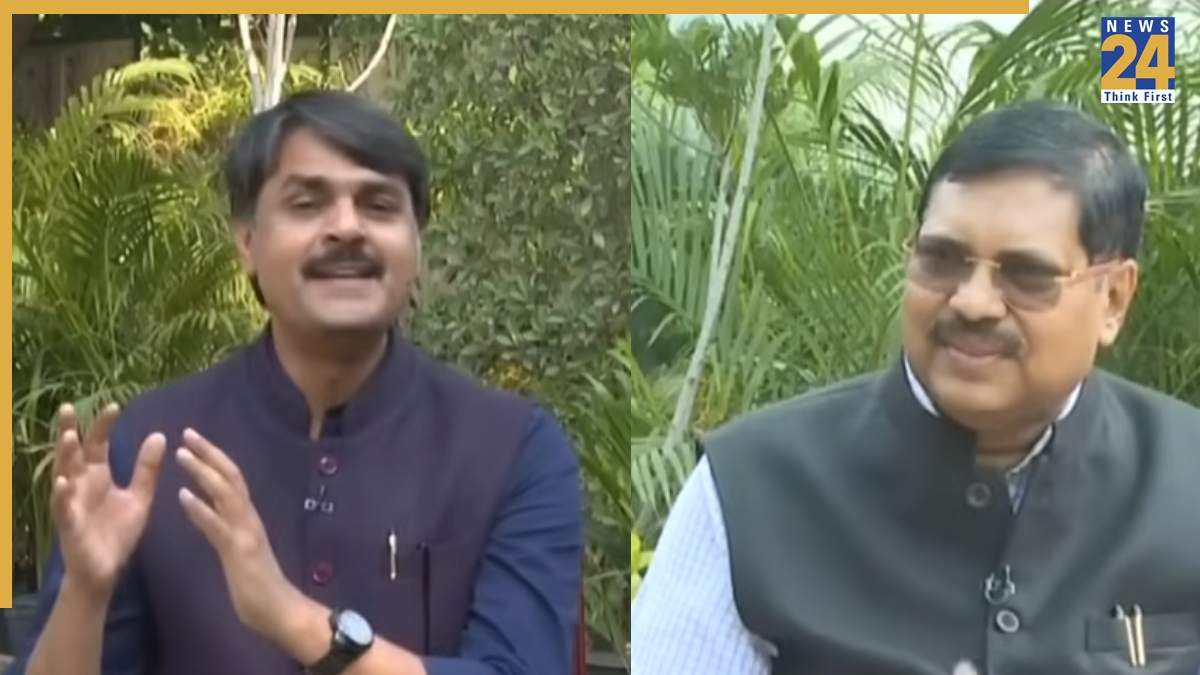
Upon being asked, why his opinions on the SC and ST reservation’s creamy layer is opposed so vehemently even when its execution will lead to the benefits of the same community in a much greater manner? and how One officer even went so far as to say that until a Brahmin gives his daughter in marriage to his son, he should continue receiving reservation benefits?
Upon facing the question Br Gavai said that i have seen dalit officers being married to upper caste girls, i believe that SC and ST reservation should have a creamy layer filter as it would allow the benefits to reach to the people who are much more in need of the support and help.
“I have seen that officers from the Dalit community have married upper-caste girls. I believe that there should be a system like the creamy layer in SC-ST reservation. By doing this, the benefits of reservation will reach the truly needy people of the SC-ST community. I had also said this in my judgment.
Ex Chief justice Br Gavai has always been an ardent supporter of the concept of creamy layer in the SC and ST reservation, while addressing a programme at the Living India Constitution at 75 years, Gavai spoke about the inclusion quite clearly, he opined that children of IAS officer can not be equated with the offsprings fo a poor agricultural labourer when it comes to reservations. He added
“I also went further and took a view that the concept of creamy layer, as has been found in the judgment of Indra Sawhney (vs Union of India & Others). What is applicable to the Other Backward Classes, should also be made applicable to Scheduled Castes, though my judgment ha been widely criticised on that issue”
“But I still hold that judges are not supposed to normally justify their judgments, and I still have about a week to go [retirement],” Gavai further said. that it has been widely criticised on that issue,”


PM Modi fulfilled Ambedkar’s wish by abolishing Article 370, says 99-year-old Hande
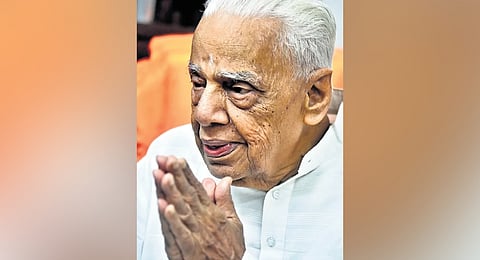
Dr HV Hande, who took part in the Quit India protests as a college student in Mangalore, and later worked under Rajaji as a functionary of the Swatantra party and in the 1980s as a Health Minister in the Cabinets headed by Chief Minister MG Ramachandran, celebrated his 99th birthday on Friday. People from all walks of life, including politicians, judges, and doctors called on him. Amid wishes that poured in, Dr Hande answered a few questions from T Muruganandham. Edited excerpts:
What are some of your unforgettable moments with leaders like Rajaji, MGR and Kamaraj?
When I was heading the state unit of the Swatantra Party in the 1970s, Rajaji wanted me to issue a statement on an issue. But I thought it would add strength to DMK, which was then an opponent of the Swatantra party. I agreed hesitantly and was about to enter my car, when Rajaji’s PA, SP Subramanyam, came running, saying Rajaji wanted to have a word.
Rajaji told me, “You did not agree with me in issuing a statement. But agreed on my insistence. You should have had the courage to disagree. Never do anything which your conscience does not allow. You don’t have to give a statement on the issue. I am not compelling you.” I was really amazed that a leader of his stature allowed someone who worked under him to express their wish. I am saying this to imply how Rajaji disliked hero worship.
People have not really appreciated the contribution of Kamaraj to Tamil Nadu’s growth. Many key projects, which might have gone to other states, came to Tamil Nadu because the good equation he shared with Prime Minister Jawaharlal Nehru. Kamaraj did a lot for infrastructure building during his nine years in power. Kamaraj could achieve this because he could delegate work to the right person.
What is your take on debates in Assembly these days?
It is a little tragic, I would say. A head-on collision with the central government. There is not even a small area of agreement. That will not help the state. It would be better if Chief Minister MK Stalin mends his fences with the centre. We require the help of the union government in several areas.
Who is your greatest icon?
My greatest icon is Dr Ambedkar because he had the foresight to strongly oppose the introduction of Article 370, which gave special status to Jammu and Kashmir, stating that it would isolate Jammu and Kashmir. Seventy years later, Ambedkar’s wish was fulfilled by Prime Minister Narendra Modi by abolishing Article 370.

Caste, Politics, And Power: Adi Dravidas in the Dravidian Model
The Dravidian Movement has shaped Tamil Nadu’s politics for over a century. Yet, despite its professed commitment to social justice, the movement has a complex legacy of excluding Dalits and consolidating caste majorities in power. From the first non-Brahmin ministry in 1920 to contemporary struggles over reservation and caste-based violence, the story of Dalits in the Dravidian model reveals the limits of political empowerment in a state celebrated for its social reforms.
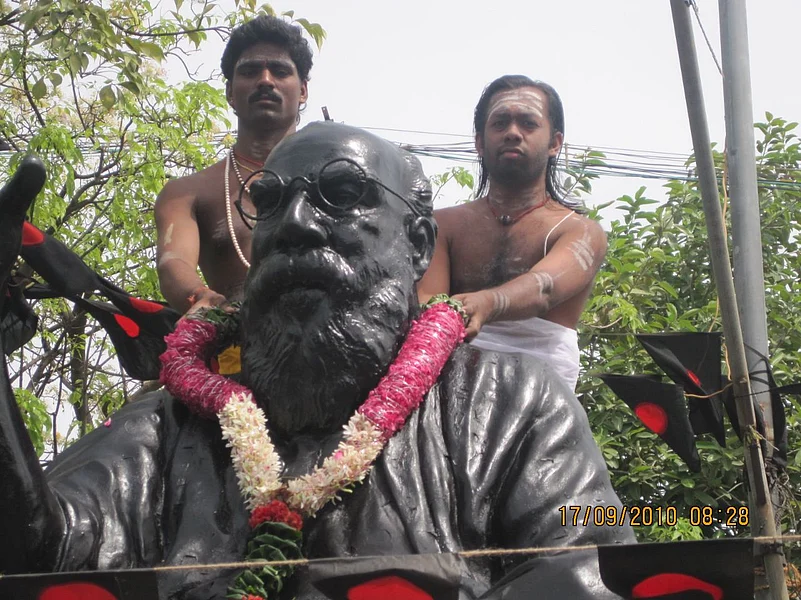

The Dravidian Movement in Tamil Nadu, beginning with the Justice Party in 1920, aimed to challenge Brahminical dominance but often excluded Dalits from its vision of social justice.
Over the past century, the Dravidian Movement consolidated political power among caste majorities, leading to both societal and state-sanctioned violence against Dalits.
Despite decades of reforms and affirmative action, Dalits in Tamil Nadu continue to face exclusion, underrepresentation, and discrimination, highlighting the limitations of the so-called “Dravidian Model.”
The national media is immersed in celebrating 100 years of the Rashtriya Swayamsevak Sangh (RSS), but it hardly gives any space to discussing the century-old Dravidian Movement of Tamil Nadu, which is ideologically opposed to the RSS. The Justice Party — the forerunner of the Dravidian Movement — captured power in the Madras Presidency in 1920. The Self-Respect Movement and the Dravidar Kazhagam founded by E.V.R. Periyar, and the DMK, an offshoot of the Dravidar Kazhagam founded by C.N. Annadurai, are all part of this larger Dravidian tradition.
Initially, the Dravidian Movement spoke of including Dalits and other marginalised groups. Later, however, it abandoned this vision and began suppressing Dalits. This shift occurred because the Dravidian Movement eventually became a political instrument of the caste majority in Tamil Nadu.
“In India, the majority is not a political majority. In India the majority is born; it is not made. That is the difference between a communal majority and a political majority. A political majority is not a fixed or a permanent majority. It is a majority which is always made, unmade and remade. A communal majority is a permanent majority fixed in its attitude. One can destroy it, but one cannot transform it,” said Ambedkar.


Comments
Post a Comment